
For some players, poker isn’t just about skill, strategy and luck: There’s an element that might be quite surprising, which is superstition. Players around the world use lucky items and follow special habits to try and improve their chances. These beliefs don’t actually change the cards, but they can help players feel more confident and in control. Even though there’s no scientific proof they work, superstitions can affect how someone thinks and plays during a game.
For instance, during the 2005 World Series of Poker Main Event, Steve Dannenmann adhered to several superstitions, such as only riding in even-numbered taxi cabs and wearing the same shirt for seven consecutive days. He also avoided letting his wife watch him play, believing her absence brought good luck. These rituals coincided with his impressive second-place finish, earning him $4.25 million. Similarly, Daniel Negreanu, one of the most recognizable faces in professional poker, has his own unique pre-tournament ritual (this goes more under the mental game): Watching the Rocky movie franchise. He believes this routine inspires and mentally prepares him for the challenges of high-stakes games.
As poker expands beyond physical tables into digital arenas, these habits are finding new life online. Online casinos such as CasinoFriday, have observed players bringing their real-world superstitions into virtual play whether it’s choosing a lucky avatar, logging in at a specific time or sticking to a certain digital poker room layout. These rituals that derive from superstition may seem trivial but for many, they offer a mental edge. In online poker, where physical tells are absent, routine and familiarity can provide a sense of control and confidence. Whether at a live tournament or on an online platform, the blend of tradition, belief and psychological comfort continues to be a central part of poker culture worldwide.
What Are Some Common Superstitions Among Poker Players
Poker players often embrace a variety of superstitions and rituals, believing these practices can influence their luck and performance at the table. These customs serve as psychological tools, providing a sense of control and confidence during the uncertainties of the game.
One common superstition among poker players is that crossing one’s legs during play can “cross out” good luck, potentially leading to a losing streak. This belief suggests that crossing legs disrupts the flow of positive energy, hindering a player’s chances of success. While the origins of this superstition are unclear, it remains prevalent in poker culture, with many players consciously avoiding this posture to maintain favourable outcomes.
The use of lucky charms is widespread among gamblers, with items like rabbit’s feet, four-leaf clovers and horseshoes commonly carried to attract good fortune. These talismans are believed to possess mystical properties that can sway luck in a player’s favor. The rabbit’s foot, for instance, has roots in ancient Celtic and Native American traditions, where it was considered a powerful amulet. Similarly, the four-leaf clover, originating from Irish folklore, is cherished for its rarity and association with good luck. Players often personalize their lucky charms, incorporating items such as specific coins, jewellery or even clothing believed to bring them luck.
Another prevalent superstition is the dislike to $50 bills. Many players refuse to accept or use them, considering them unlucky. This belief is rooted in historical associations, including the notion that $50 bills were commonly counterfeited, leading to financial losses. Additionally, urban legends suggest that notorious figures, such as Bugsy Siegel, were found with $50 bills at the time of their demise, further cementing the bill’s ominous reputation.
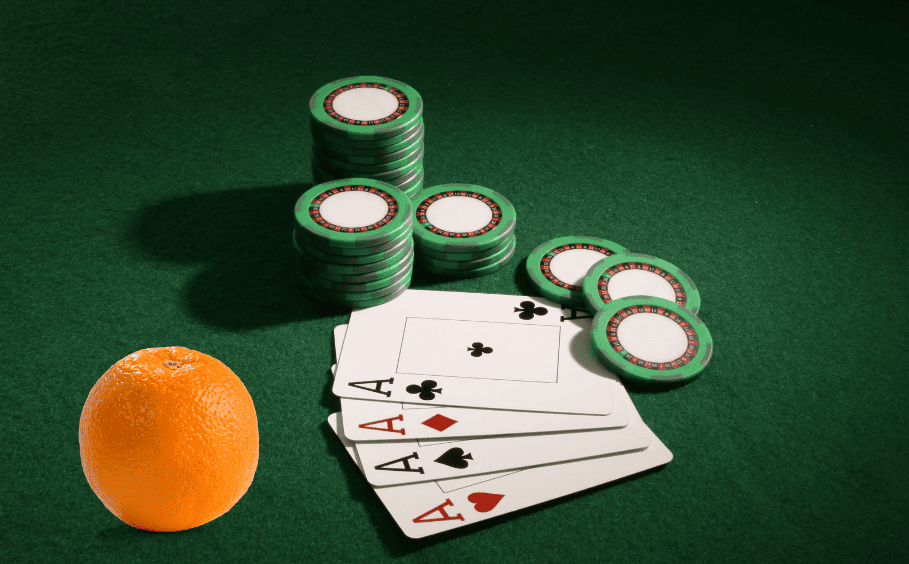
Orange at the table
Johnny Chan, a ten-time WSOP bracelet winner, is renowned for placing an orange next to his chips during games. This practice began as a means to counteract the smoke-filled poker rooms of the past, allowing him to inhale the citrus scent for relief. Over time, the orange became a symbol of good luck and a staple in his poker routine.
Chan’s use of the orange started in the 1980s when he quit smoking but still had to endure the smoke-filled air of poker rooms. To combat the cravings and the unpleasant environment, he began bringing an orange to the table, using its scent as a natural air filter. This habit not only helped him cope with the smoky atmosphere but also became a psychological comfort during high-stakes games. Even after smoking bans were implemented in casinos, Chan continued to bring the orange, transforming it into a personal good luck charm. His consistent success, including back-to-back WSOP Main Event victories in 1987 and 1988, further cemented the orange’s status as a symbol of his poker prowess. Chan’s ritual has since become one of the most recognizable superstitions in the poker world, illustrating how personal habits can evolve into legendary trademarks.
Unlit Cigarette
Sammy Farha, a prominent figure in the poker world, is instantly recognizable by the unlit cigarette he keeps between his lips during play. Interestingly, Farha is a non-smoker; the cigarette serves purely as a lucky charm. He attributes his success, including multiple WSOP titles to this peculiar ritual.
Farha’s unlit cigarette has become an iconic part of his poker persona. The ritual began when a friend offered him a cigarette for luck during a losing session. Although he didn’t light it, he held it in his mouth and subsequently experienced a winning streak. Since then, he has maintained this practice, believing it brings him good fortune. Notably, during the 2003 WSOP Main Event, Farha reached the final table, ultimately finishing as the runner-up to Chris Moneymaker. Throughout the tournament, his unlit cigarette was ever-present reinforcing its association with his deep run in one of poker’s most memorable events. Farha’s commitment to this superstition extends further; if he loses a hand, he immediately replaces the cigarette with a new one, believing that a fresh cigarette resets his luck.
Casper the Friendly Ghost
Poker legend Doyle Brunson, despite claiming not to be superstitious, often spoke to a card protector he dubbed “Casper the Friendly Ghost.” He joked that this ghost brought him luck during games. Brunson even humorously “rented” Casper to other players for a fee, highlighting how superstition can blend with poker culture. Brunson’s “Casper” was a black lighter adorned with the Ghostbusters logo and the inscription “Texas Dolly.”
He began using it as a card protector in the 1980s, initially as a jest, conversing with it and requesting good fortune. Surprisingly, he noticed that many of his wishes seemed to materialize, leading him to continue the practice. Other players took note of this ritual and expressed interest in borrowing Casper, prompting Brunson to rent it out for $500 per 30 minutes. At its peak, Casper was rented for $5,000 for an hour by a player from Greece. Eventually, Brunson sold Casper to fellow poker professional Howard Lederer for $3,500, with the agreement that Brunson would retain possession of the charm until his passing, after which it would be bequeathed to Lederer as stipulated in his will.
Cowboy Attire
Hoyt Corkins, affectionately known as the “Cowboy,” is a seasoned professional poker player renowned for his distinctive attire and aggressive playing style. Originating from Glenwood, Alabama, Corkins began his poker journey at the age of 19, learning the game from his father. He quickly made a name for himself in the poker world, earning two WSOP bracelets and two World Poker Tour (WPT) titles. His consistent success on the circuit has solidified his reputation as a formidable player.
Corkins’ signature cowboy hat and boots have become synonymous with his persona at the poker table. This distinctive attire not only sets him apart visually but also reflects his deep-rooted connection to his Southern heritage. The nickname “Cowboy” was affectionately bestowed upon him by WPT commentator Mike Sexton, who noted Corkins’ consistent choice of cowboy hats during tournaments. While Corkins has occasionally opted for a visor, he has expressed a desire to bring the cowboy hat back when making deep runs in tournaments.
Beyond his attire, Corkins is known for his aggressive and unorthodox playing style, earning him additional nicknames such as “Mr. Move All-In” from Phil Hellmuth and “Nightmare” from fellow players. This bold approach to the game has made him a memorable figure in poker history. Additionally, Corkins often wears earplugs during live tournaments to minimize distractions from opponents’ chatter, allowing him to maintain focus and composure.
Final Thoughts
While superstitions may not influence the cards dealt, they can significantly affect a player’s mindset. Rituals and lucky charms can boost confidence, reduce anxiety and create a sense of routine, all of which can contribute to better decision-making at the table. Psychologist Stuart Vyse notes that such rituals can reduce stress and improve performance, not because they are superstitious but because they are rituals that provide a calming effect before high-pressure activities.
As players continue to seek any edge they can find in poker games, the world of poker will undoubtedly remain intertwined with superstition and ritual. These beliefs, while not scientifically proven to influence outcomes, play a significant role in the psychological preparation and performance of players. Understanding the impact of these rituals can offer deeper insights into the mental aspects of poker and the human inclination to find patterns in the face of uncertainty.
- SCCG Management. The Gambling Industry’s Global Connector. Access Here.
- Source: https://beastsofpoker.com/superstitions-and-rituals-in-poker/