
By Laid Back Llama.
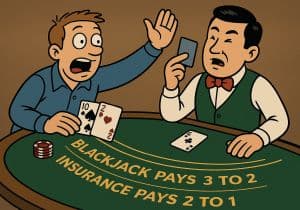
You’re sitting at third base. Dealer shows a 6. You’ve got 12. Everyone at the table is watching.
You hit. Bust. The table groans. “You took the dealer’s bust card.”
But here’s the thing: you made the right play. And that’s why blackjack is so hard.
When Correct Feels Wrong
Basic strategy tells you to stand on 12 against a dealer 6. The math is clear. But sometimes you hit anyway when the count is high, or you have a feeling, or last time you stood you lost.1)<a class="glossaryLink" aria-describedby="tt" data-cmtooltip="
” href=”https://www.blackjackreview.com/wp/encyclopedia/d/#MichaelDalton” data-mobile-support=”0″ data-gt-translate-attributes=”[{"attribute":"data-cmtooltip", "format":"html"}]” tabindex=”0″ role=”link”>EDITOR NOTE: The count has to negative to justify hitting a 12 versus 6. For the Hi-Lo count, the 6-deck index is -3 or -1 depending on whether the dealer hits on soft-17 or not.
This is where most blackjack players fail. Not because they don’t know basic strategy. Because they can’t follow it when it feels wrong.
The Psychology of Perfect Information
Chess players can see the entire board. Poker players get information from betting patterns. Blackjack players get <a class="glossaryLink" aria-describedby="tt" data-cmtooltip="
” href=”https://www.blackjackreview.com/wp/catalog/basic-strategy-cards/” data-mobile-support=”0″ data-gt-translate-attributes=”[{"attribute":"data-cmtooltip", "format":"html"}]” tabindex=”0″ role=”link”>basic strategy charts that tell them exactly what to do.
And yet they still lose.
Why? Because knowing the correct play and making the correct play are different skills. The first is memorization. The second is discipline.
What Simple Games Teach Complex Players
Here’s something interesting: sometimes the simplest games teach the most valuable lessons about decision making.
Take something as basic as rock paper scissors. No cards to count. No strategy charts to memorize. Just a pure decision with three options.
When you play rock paper scissors online, you face the same psychological challenge as blackjack: can you make decisions based on probability instead of emotion?
Most people can’t. They see patterns that don’t exist. They get tilted after losses. They overthink simple choices.
Sound familiar?
Why Blackjack Players Think They’re Different
The average blackjack player thinks they’re special. They’ve read books. They’ve memorized basic strategy. They understand the math.
But put them at a table for four hours and watch what happens. They deviate from strategy because “it’s a hot deck.” They split tens because they’re up money. They take insurance because “it feels right.”
All the knowledge in the world doesn’t matter if you can’t control your impulses.
The Variance Problem
You can play perfect basic strategy and lose ten hands in a row. The math says you’ll win long-term.2)<a class="glossaryLink" aria-describedby="tt" data-cmtooltip="
” href=”https://www.blackjackreview.com/wp/encyclopedia/d/#MichaelDalton” data-mobile-support=”0″ data-gt-translate-attributes=”[{"attribute":"data-cmtooltip", "format":"html"}]” tabindex=”0″ role=”link”>EDITOR NOTE: In actuality, you will still lose long-term playing perfect <a class="glossaryLink" aria-describedby="tt" data-cmtooltip="
” href=”https://www.blackjackreview.com/wp/catalog/basic-strategy-cards/” data-mobile-support=”0″ data-gt-translate-attributes=”[{"attribute":"data-cmtooltip", "format":"html"}]” tabindex=”0″ role=”link”>blackjack basic strategy. But, you will lose the least amount of money. Basic strategy alone can not beat the inherent house edge. Not playing a correct basic strategy only increases the house edge against you. But sitting there watching your stack disappear short term breaks people.
This is where card counters have an edge over basic strategy players. Not because counting is that much better mathematically. Because it gives them something to do. Something to focus on besides the emotional pain of losing.
Basic strategy players just sit there and take it. And eventually, they crack.
When Knowledge Becomes a Burden
Once you learn basic strategy, every deviation haunts you. You hit when you should stand. You know you’re wrong. But you do it anyway because you’re frustrated or scared or tilted.
It’s actually worse than not knowing. Because now you’re aware you’re making mistakes in real time. You’re watching yourself lose money and unable to stop.
The Discipline Gap
The gap between knowing what to do and doing it is where casinos make their money. Not on tourists who don’t know basic strategy. On players who know it but can’t follow it.
These players are the most profitable. They understand odds well enough to keep playing. But they lack the discipline to actually beat the game.
Why Simple Decisions Are Hard
Three options. Rock, paper, scissors. One beats one, loses to another. Couldn’t be simpler.
And yet, when real stakes are involved, people mess it up. They look for patterns in randomness. They tilt after losses. They overthink the simple choice.
This is human nature. We see faces in clouds. We find meaning in noise. We can’t help ourselves.
What This Means for Your Blackjack
If you can’t make a simple three choice decision without emotion interfering, how are you going to navigate the complexity of blackjack?
Multiple decks. Different rules. Dealer tells. Count adjustments. The decisions get more complex while your emotional control stays exactly the same.
The truth is most blackjack players never develop real discipline. They just get better at justifying their deviations from strategy.
The Practice Nobody Does
You want to improve at blackjack? Don’t memorize more charts. Learn to control your emotional reactions to outcomes.
Play games where there’s no strategy to hide behind. Games where every loss is 100% on you. Games where you can’t blame the dealer or other players or bad luck.
When you can make optimal decisions consistently in simple scenarios, then you’re ready for the complexity of blackjack.
Why Card Counters Win
Card counters aren’t just better at math. They’re better at emotional control. They’ve developed the discipline to follow a system regardless of short term results.
They can lose all night and keep betting correctly. They don’t tilt. They don’t deviate. They stick to the plan.
That discipline is more valuable than the counting system itself.
The Hidden Cost of Emotion
Every time you deviate from basic strategy because of emotion, you pay a price. Sometimes you get lucky and win anyway. That’s the worst outcome because it reinforces bad habits.
Most of the time you lose. And you know you shouldn’t have made that play. But the emotional cost of standing there and following strategy felt worse than the financial cost of deviating.
This is how casinos win. Not through better odds. Through exploiting human psychology.
What Losing Teaches You
Losing at blackjack when you played correctly teaches nothing. You already knew you could lose. That’s why it’s called gambling.
Losing at simple games teaches something different. It shows you where your decision making breaks down. Where emotion takes over. Where discipline fails.
Those lessons apply everywhere. Trading. Poker. Life decisions. Anywhere you need to follow a strategy despite short-term noise.
The Path Most Players Don’t Take
Most blackjack players study more strategy. Learn more systems. Memorize more charts.
Smart players study their own psychology. They figure out when they tilt. What triggers emotional decisions. How to recognize when they’re about to deviate.
The game isn’t primarily about cards. It’s about whether you can control yourself while the cards do whatever they’re going to do.
Why This Matters More Than You Think
You can memorize perfect basic strategy in a weekend. You can learn to count cards in a month. You can understand every nuance of the game in a year.
Developing the discipline to actually follow your strategy? That takes years. Maybe never happens for most people.
That’s why the casino edge exists. Not because the math favors them that much. Because humans can’t follow optimal strategy consistently enough to beat them.
The Uncomfortable Truth
If you’re not winning at blackjack with perfect basic strategy, the problem isn’t your knowledge. It’s your execution.
And if you can’t execute a simple strategy in a simple game, you won’t execute a complex strategy in a complex game.
The path to better blackjack isn’t more study. It’s more discipline. And discipline comes from practice in environments where you can’t hide from your mistakes.
Where to Start
Start with the simplest decision making scenarios. Games where strategy is trivial but execution still requires discipline. Games where you can see immediately when emotion interferes with optimal play.
Master making simple decisions correctly. Then move to more complex ones. Build the foundation before you try to construct the house.
Most players try to learn blackjack by jumping straight into the deep end. They memorize charts without developing decision making discipline. Then they wonder why they keep making mistakes they know are mistakes.
Overview
Blackjack isn’t hard because the strategy is complex. It’s hard because following strategy when you’re losing is psychologically brutal.
No amount of knowledge fixes this. Only practice making decisions without emotional interference helps.
And sometimes that practice is better done with simpler games that strip away complexity and force you to confront the real issue: can you make optimal decisions consistently?
That’s the skill that separates winners from losers. Not in blackjack specifically. In any game involving decisions under uncertainty.
Master that skill and blackjack becomes easier. Ignore it and you’ll keep making the same mistakes regardless of how much you study.
IMAGE CREDIT: Microsoft AI Copilot
- SCCG Management. The Gambling Industry’s Global Connector. Access Here.
- Source: https://www.blackjackreview.com/wp/2026/01/25/the-blackjack-decision-you-keep-getting-wrong/